
MSP Rankings · Retail Industry
Best MSPs for the Retail Industry (2026)
enVista (6.6/10) pairs retail commerce with supply-chain depth, and Retail Technology Group (5.7/10) specializes in multi-location POS rollouts. Every score reflects the itreviews.co Trust Score methodology applied identically. No provider submitted their own data.
Quick Picks
- Best Overall: TPx Communications
- Best for C-Store, QSR & Multi-Site Chains: SageNet
- Best for Multi-Location POS Rollouts: Retail Technology Group
- Best for SMB Retailers Who Want Verified Reviews: IT GOAT
- Best for Omnichannel & Supply-Chain-Heavy Retail: enVista
Retail IT breaks in ways other industries never see. A frozen point-of-sale terminal on Black Friday isn’t a help-desk ticket. It’s lost revenue, a line out the door, and a customer who shops somewhere else next time. That’s the job a retail MSP signs up for: keeping payment systems, store networks, and back-office tools running across every location, every hour you’re open.
This ranking covers the managed service providers that actually do retail work, not generalists who added a retail page to their site. We scored each one with the itreviews.co Trust Score methodology, the same six factors applied the same way to everyone. Card-accepting retailers carry real exposure here: retail organizations weathered a 15% jump in cyber incidents year over year, with attackers shifting from card data toward customer credentials and internal plans, according to Verizon’s 2025 Data Breach Investigations Report. The provider you pick is part of your defense.
One honest note up front. The retail MSP market splits in two. A handful of enterprise network specialists run thousands of stores but collect almost no public reviews. A second group of smaller MSPs carries strong review profiles but treats retail as one vertical among many. We scored both pools on identical criteria and flagged every data gap. That’s the whole point of a transparent method.
How We Ranked These Retail MSPs
Every provider on this list was scored using the same six-factor Trust Score, weighted identically and applied without exception. Reviews count for 35%, awards 20%, tenure 15%, then physical presence, retail specialization, and service breadth at 10% each. Review counts are scaled logarithmically — a provider serving 40 large chains isn’t punished against one serving 400 small shops.
Trust Score Factors — Retail MSP Rankings
Two things to know about the data. Most of the deepest retail specialists here have little or no Clutch presence, which the model treats as a mild negative on the review factor. And one provider, HTG, returned no public review data we could verify, so its review score reads as zero and its overall position sits low for that reason alone, not because of any quality judgment. Where data was missing, we said so rather than guessing.
Every provider on this page is scored identically. See the full methodology →
Retail MSP Comparison at a Glance
| Provider | Trust Score | Best For | Key Strength | HQ | Notable Limitation |
|---|---|---|---|---|---|
| TPx Communications | 8.0/10 | Multi-vendor retail IT consolidation | Top-10 MSP 501, full UCaaS + security stack | Austin, TX (national) | Thin public Google review volume |
| IT GOAT | 7.3/10 | SMB retailers wanting verified reviews | Strongest verified review profile + Inc. 5000 | Dallas, TX (national) | Young firm; retail is one of several verticals |
| SageNet | 6.7/10 | C-store, QSR, multi-site chains | Deepest retail and c-store network specialization | Tulsa, OK (national) | Network-centric, lighter on SMB help-desk MSP work |
| enVista | 6.6/10 | Omnichannel and supply-chain-heavy retail | Retail commerce + supply chain depth | Carmel, IN (global) | More consulting and commerce than classic MSP |
| Synergy Technical | 6.0/10 | Microsoft-first retail environments | Microsoft Gold security and cloud depth | Richmond, VA | Microsoft-centric, thin review volume |
| Retail Technology Group | 5.7/10 | Multi-location POS rollouts | Pure retail and restaurant POS deployment | Fenton, MO (national) | Deployment-focused, narrower managed stack |
| HTG Inc. | 4.0/10 | Regional retailers wanting rollout plus MSP | Store-in-a-box rollouts + full MSP stack | Tigard, OR (nationwide field) | No public review data located |
The 7 Best MSPs for Retail in 2026
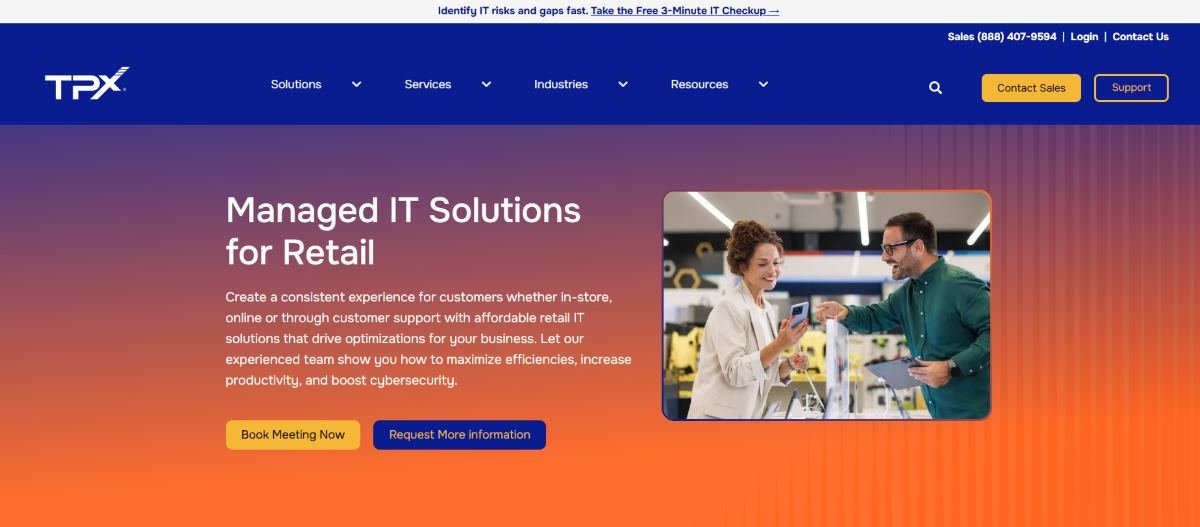
One vendor for connectivity, voice, security, and POS support across every store. That’s the pitch, and TPx has the track record to back it.
Key Strengths
- Ranked in the top 10 on the 2025 Channel Futures MSP 501, and on CRN’s MSP 500 Elite 150 for eight straight years.
- A retail practice that names the actual problems — point-of-sale security, cardholder data protection, and store network uptime.
- Full stack under one contract: managed IT, UCaaS, secure networking, SASE, cybersecurity, backup, and compliance.
- Founded in 1998, with national reach and US-based support, not a regional shop stretching to cover you.
Limitations
- Public Google review volume is thin (a corporate-office listing, not a reflection of client base size), so buyers who lean on star ratings won’t find much.
- Built for chains and mid-market brands. A single boutique may pay for scale it won’t use.
Best For
Multi-location retailers tired of juggling separate vendors for internet, phones, security, and store support.Not Ideal For
Single-store operators who just need occasional break-fix help.Why They Rank #1
TPx earns the top spot the way a retail MSP should, by pairing a documented retail practice with the deepest award shelf on this list and the broadest service stack. The weak point is reviews, and the model docks them for it. But a top-10 MSP 501 finish, eight consecutive years on CRN’s Elite 150, and a payment-security focus that maps directly to how retailers actually get breached carry more weight than a handful of star ratings ever could. For a chain that wants its IT, phones, network, and security answered by one accountable partner, this is the cleanest fit in the market.
When you want proof other retailers trust a provider, IT GOAT brings the receipts.
Key Strengths
- A 4.7 rating across 13 verified Clutch reviews plus a 5.0 across 78 Google reviews, the best combined review profile in this group.
- Real retail clients in the mix, including food and beverage and a bicycle retailer running managed IT through them.
- Named to the 2024 Inc. 5000 at No. 62 nationally, plus CRN’s Fast Growth 150 and Tech Elite 250.
- Full MSP stack with cybersecurity and compliance depth, including CMMC work.
Limitations
- Founded in 2018, so it’s the youngest firm here by a wide margin.
- Retail is one of many verticals, not a dedicated practice, so it lacks the multi-site POS and c-store depth of the specialists.
- A few client reviews flag billing and ticket-response timing as areas to watch.
Best For
Small and mid-size retailers who want a fast-growing MSP with public, verifiable proof of service.Not Ideal For
National chains running hundreds of stores that need purpose-built multi-site network management.Why They Rank #2
Reviews drive 35% of the score, and IT GOAT simply has the data nobody else here can match. That alone lifts a seven-year-old firm above specialists three times its age. The honest gap is depth. They’re a strong general MSP that does retail, not a retail-first operation, so a 400-store rollout isn’t their natural home.
If your problem is keeping technology alive across hundreds or thousands of locations, this is the name that keeps coming up.
Key Strengths
- Manages communications across roughly 220,000-plus endpoints for some of the country’s largest retail, c-store, and restaurant brands.
- A genuine retail and convenience-store practice covering POS, guest Wi-Fi, digital signage, PCI compliance, and video-at-the-pump.
- US-based 24/7 NOCs and SOCs plus a nationwide field-service organization, built for reliability at scale.
- Exhibits at the NRF Big Show, the retail industry’s flagship event, which says something about where they live.
Limitations
- Network and connectivity is the center of gravity, so a small retailer wanting a classic per-user help-desk MSP may find the model heavier than needed.
- No Clutch presence and a modest Google profile (3.9 across 30 reviews on the corporate listing), which the review factor penalizes.
- Enterprise orientation means smaller brands aren’t the target customer.
Best For
Convenience stores, QSR chains, and multi-site retailers that need failover-grade uptime across every location.Not Ideal For
A single-location shop looking for light, low-cost IT support.Why They Rank #3
Here’s the tension this whole list lives inside. SageNet is the most retail-credible provider here on specialization, scoring a perfect 10 on that factor, yet it lands third because the Trust Score weights reviews and named MSP-industry awards heavily, and SageNet collects neither the way SMB-focused MSPs do. That’s not a knock on capability. It’s what happens when an enterprise network operator that runs the nation’s biggest store fleets gets measured on the same review-driven yardstick as everyone else. For large multi-site brands, SageNet may well be the right call regardless of where the number lands.
A retail technology firm that thinks in inventory, orders, and omnichannel, not just tickets.
Key Strengths
- Founded in 2002 with a retail and omnichannel practice serving hundreds of retailers, distributors, and manufacturers.
- Depth where retailers actually struggle, including unified commerce, order management, and supply chain alongside IT.
- Named to CRN’s MSP 500 and Tech Elite 250, plus recognition from Food Logistics and Supply & Demand Chain Executive.
Limitations
- Leans toward consulting, software, and commerce work more than day-to-day managed IT, so the help-desk-and-endpoint side is lighter.
- Thin public review signal (a 4.0 Google rating across 13 reviews), no Clutch profile.
Best For
Omnichannel retailers whose biggest gaps are commerce platforms, order management, and supply chain technology.Not Ideal For
A brick-and-mortar chain that mainly needs store networks and POS kept running.Why They Rank #4
enVista is the most specialized retail name here after SageNet, and the tenure and awards hold up. It sits fourth because its center of gravity is commerce and supply chain consulting rather than the managed IT operations most store-level buyers picture. Right firm, slightly different job.
Built around the Microsoft stack, and proud of it.
Key Strengths
- A Microsoft Gold partner with a Security Deployment Partner Award, so Microsoft 365, Azure, and Microsoft security are the home turf.
- A 4.9 Google rating across 8 reviews, the highest rating among the specialists even if the count is small.
- A clear retail managed IT offering that swaps unpredictable break-fix spend for a flat monthly model.
Limitations
- Microsoft-centric by design, which is a strength if you’re all-in on that ecosystem and a constraint if you aren’t.
- A claimed but empty Clutch profile and low overall review volume limit the verified proof.
- Smaller operational footprint than the national players above.
Best For
Retailers standardized on Microsoft 365 and Azure who want a partner fluent in that environment.Not Ideal For
Mixed-platform or hardware-heavy retail environments that need vendor-agnostic support.Why They Rank #5
Solid, focused, and well-rated where it counts. Synergy’s ceiling is its specialty. Going deep on Microsoft is exactly why some retailers will love them and others will look elsewhere.
Opening 50 stores this year? This is the team that gets every register live on time.
Key Strengths
- A retail-only firm since 2003, focused on POS deployment for retail, restaurant, hospitality, and convenience brands.
- Nationwide field coverage across the US and Canada, with staging, configuration, and logistics handled before hardware ships.
- End-to-end rollout muscle, from planning to install to 24/7 support, tuned for stores at scale.
Limitations
- Deployment is the strength, which means the ongoing managed stack (cybersecurity, cloud, vCIO) is narrower than a full-service MSP.
- A 3.9 Google rating across 29 reviews, no Clutch presence, so verified review signal is limited.
- Best as a rollout and POS partner, less so as your everyday IT department.
Best For
Retail and restaurant brands running new-store rollouts, remodels, or large POS refresh projects.Not Ideal For
A business that wants one provider for security, cloud, help desk, and strategy year-round.Why They Rank #6
RTG does one thing extremely well, and the score reflects both halves of that sentence. Deep retail specialization pulls it up. A deployment-first model with a lighter managed-services layer pulls it back. For rollouts, few names fit better.
A real managed service provider that also runs store-in-a-box rollouts, which is a rarer combination than it sounds.
Key Strengths
- Operating since 1996, the longest tenure on this list, with a full MSP stack plus nationwide deployment.
- A documented retail IT practice covering POS, guest Wi-Fi, store rollouts, PCI, SOC 2, and cyber-insurance readiness.
- One partner for help desk, NOC/SOC, vCISO, procurement, and 50-state field work, useful for brands scaling location by location.
Limitations
- No public review data could be located on Google or Clutch, which drops the review score to zero and accounts for the low overall position.
- Headquartered in Oregon with nationwide field reach, so coverage depth varies by region.
- Smaller than the enterprise specialists above.
Best For
Regional and franchise retail brands that want rollout coordination and ongoing managed IT from the same team.Not Ideal For
Buyers who require verifiable third-party reviews before signing.Why They Rank #7
This is the clearest case of the data telling an incomplete story. HTG is a legitimate retail MSP with the longest history here and a genuinely useful rollout-plus-management model. It ranks last almost entirely because we found no public reviews to verify, and the Trust Score can’t credit what it can’t confirm. Worth a direct look if you can validate their references yourself.
How to Choose a Retail MSP
Match the provider to your store count and your risk. Single-site or small chains fit SMB-focused MSPs. Multi-location, c-store, or QSR brands need multi-site network specialists. Anyone taking card payments needs documented PCI DSS work.
Start with scale. If you run one to a few locations, IT GOAT or Synergy Technical will feel right-sized and won’t bill you for enterprise machinery. Crossing into dozens or hundreds of stores changes the question entirely — now you need centralized monitoring, standardized store kits, and failover that holds during peak trading. That’s SageNet and TPx territory.
Then look at what’s actually breaking. Opening or remodeling stores in waves? A deployment specialist like Retail Technology Group, or HTG’s store-in-a-box model, solves the rollout problem better than a pure help-desk MSP. Drowning in omnichannel and order-management issues instead? enVista lives there.
Don’t skip compliance. Every retailer that accepts cards falls under PCI DSS, the payment-card data security standard, and your MSP should be able to show how it keeps you inside it. Push past the marketing — ask for the specific controls, the monitoring approach, and the incident-response plan. The stakes are real: the average US data breach hit an all-time high of $10.22 million in 2025, and retail was one of the few sectors where costs rose rather than fell, per IBM’s Cost of a Data Breach report.
Last, weigh proof against fit. The providers with the most reviews here aren’t always the deepest retail specialists, and the deepest specialists often have the fewest reviews. Read the scores, then read the fit notes — they don’t always point the same direction, and that’s deliberate.
The Bottom Line
TPx Communications takes the top spot for retail at 8.0/10, because it pairs a documented retail practice with the strongest award record and the widest service stack on this list, all under one contract. That’s the cleanest answer for a multi-location brand that wants one accountable partner.
It isn’t the only answer. C-store, QSR, and large multi-site chains should look hard at SageNet (6.7/10), whose retail-network depth outruns its review profile. SMB retailers who want public proof before they commit will land naturally on IT GOAT (7.3/10). And brands deep in rollouts or omnichannel have purpose-built options in Retail Technology Group (5.7/10) and enVista (6.6/10).
Read the scores, weigh them against your store count and risk, and shortlist two or three. No provider paid for placement. Browse all MSP rankings or see how we score every provider.
See how we score every provider →Trust Score Breakdown
Sub-scores by factor for every provider on this list. Total weights to 10 maximum across the six factors.
| Provider | Reviews 35% | Awards 20% | Years 15% | Presence 10% | Specialization 10% | Breadth 10% | Total |
|---|---|---|---|---|---|---|---|
| TPx Communications | 6.0 | 10 | 9 | 9 | 7 | 9 | 8.0 |
| IT GOAT | 9.2 | 8 | 4 | 6 | 5 | 8 | 7.3 |
| SageNet | 4.65 | 5 | 9 | 9 | 10 | 8 | 6.7 |
| enVista | 4.8 | 6 | 9 | 8 | 9 | 7 | 6.6 |
| Synergy Technical | 6.42 | 4 | 7 | 6 | 6 | 7 | 6.0 |
| Retail Technology Group | 4.65 | 2 | 9 | 8 | 10 | 5 | 5.7 |
| HTG Inc. | 0 | 2 | 10 | 5 | 7 | 9 | 4.0 |
All factor scores are on a 0–10 scale; weights appear in the column headers. The Trust Score is the weighted total. No paid placements, no provider-submitted data.